How to use a compass for airsoft and milsim games

TL;DR
Lay a baseplate compass edge between where you are and where you want to be, dial in the bearing, correct it for the local declination, then walk the direction of travel arrow. A paper map and a phone app as backup round out the kit, and a back bearing 180 degrees from your original gets you home.
Key takeaways
- Lay the compass edge between your position and your destination, then rotate the dial to true north
- Adjust every bearing by that venue's local magnetic declination before you walk it
- A back bearing, 180 degrees from the one you walked out on, retraces your route
- Keep the compass away from car electrics, engines and steel gear, which throw off its accuracy
- Carry a paper map and compass as the plan, with a phone app as the backup
On this page
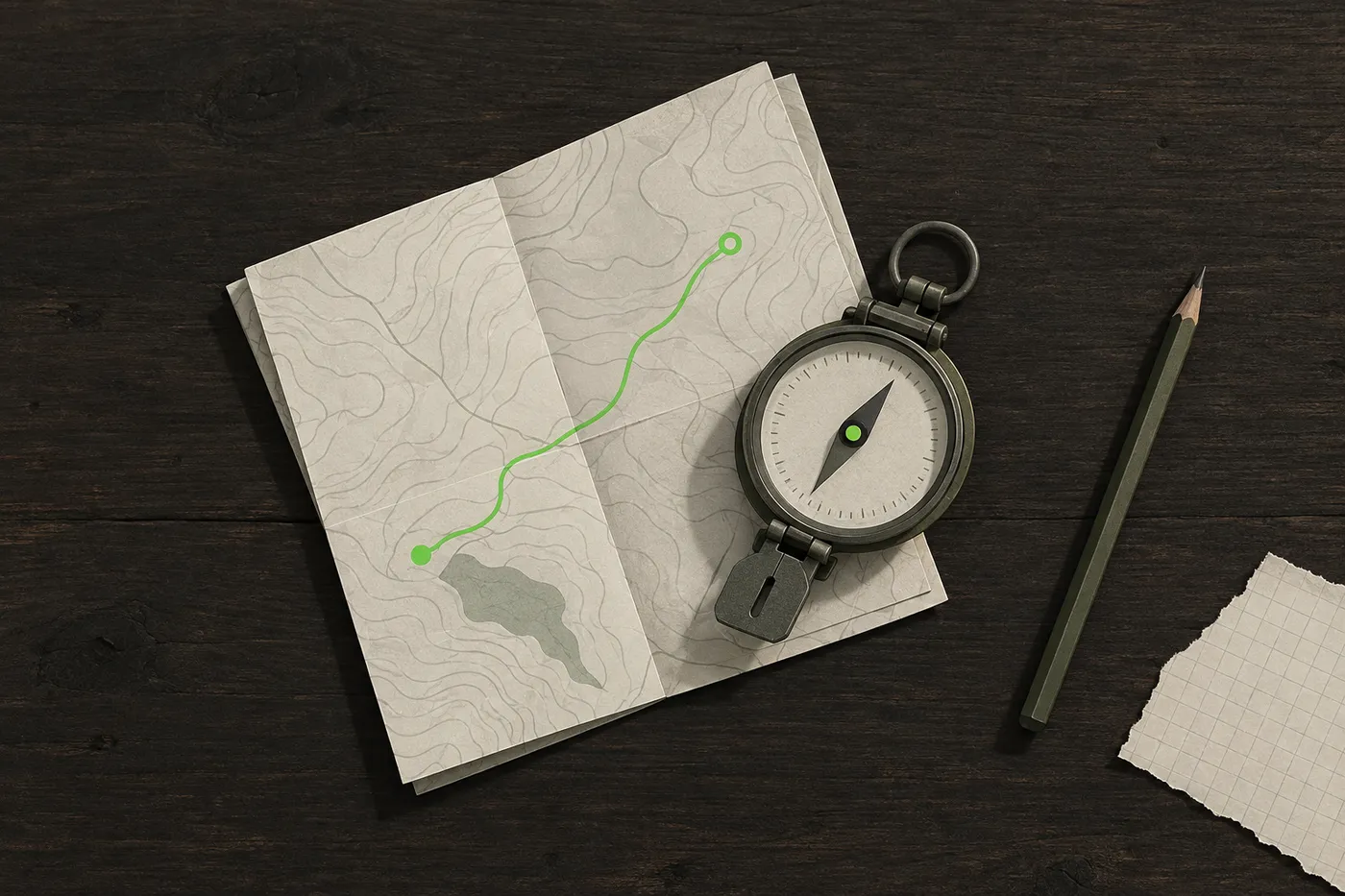
A baseplate compass has a transparent base holding a direction-of-travel indicator, built to be laid flat on a map so a bearing can be read straight off it.[1] Lay the edge between where you are and where you want to be, dial in the bearing, correct it for the local declination, and walk the direction-of-travel arrow. Ten minutes of practice before game day is enough to do all of that without hesitating in front of a squad. The single most common mistake newcomers make is reading the needle before it has stopped swinging, then walking off a few degrees wrong before they ever notice.
Bottom line: a compass does not need a signal, a battery, or an app update. It needs a steady hand and a map that matches where you are standing.
What you need
- A baseplate compass. Cheap and reliable beats expensive and fragile for a weekend field kit.
- A current paper map of the game site. Mark rally points and no-go zones on it before you need them mid-game.
- A phone with TacSync or another mapping app, kept as a backup for the compass. TacSync’s long-press on the map copies a point’s MGRS grid reference, handy for calling out a position by number instead of a landmark name once you have taken a bearing to it. Get TacSync on the App Store or Google Play.
An orienteering-style baseplate compass has a transparent base with map orienting lines and a bezel, or outer dial, marked in degrees.[1] Those two parts, plus the direction-of-travel indicator on the base, are the whole tool. Nothing else on the compass matters for a game.
For a deeper look at reading the paper map itself, contour lines, scale and grid references, see how to read a topographic map for airsoft and milsim games.
The checklist
| When | Task | Who |
|---|---|---|
| Weeks before | Practise bearings on a local map; check that day's declination for the venue | Every player |
| Week before | Print a paper map with rally points and no-go zones marked | Squad lead |
| Game day | Confirm everyone's bearings agree with the briefed grid orientation | Squad lead |
| After | Debrief what the compass caught that the phone missed, or the reverse | Whole squad |
Weeks before game day, practising bearings on a local map and checking that day’s declination for the venue avoids fumbling with the compass in front of a new squad. The week before, printing a paper map with rally points and no-go zones marked gives the squad something to take a bearing from if a phone dies or the signal drops. On game day, the squad lead confirms everyone’s compass bearings agree with the briefed grid orientation before the first push, catching a wrong bearing while it is still cheap to fix.
The steps, numbered
Step 1: Lay the compass along your route
The first step in taking a bearing on a map is laying the compass’s edge along the line connecting where you are to where you want to go.[1] Pick the point you are standing at and the point you want to reach, usually a rally point or an objective marked on the paper map, and line the long edge of the compass up between them.
Step 2: Dial in the bearing
With the compass laid against the route, the orienting lines in the base of the dial are rotated to align with true north on the map, by lining them up with a meridian or the map’s vertical margin.[1] Whatever number now sits at the direction-of-travel indicator is your bearing. Write it down, or call it over the radio, before you move.
Step 3: Correct for declination
A bearing read off the compass is converted to true north by adding or subtracting the local magnetic declination for that spot.[2] The amount changes from site to site, so check it for the venue, not from memory of the last game you played somewhere else.
Step 4: Walk it, and know your way back
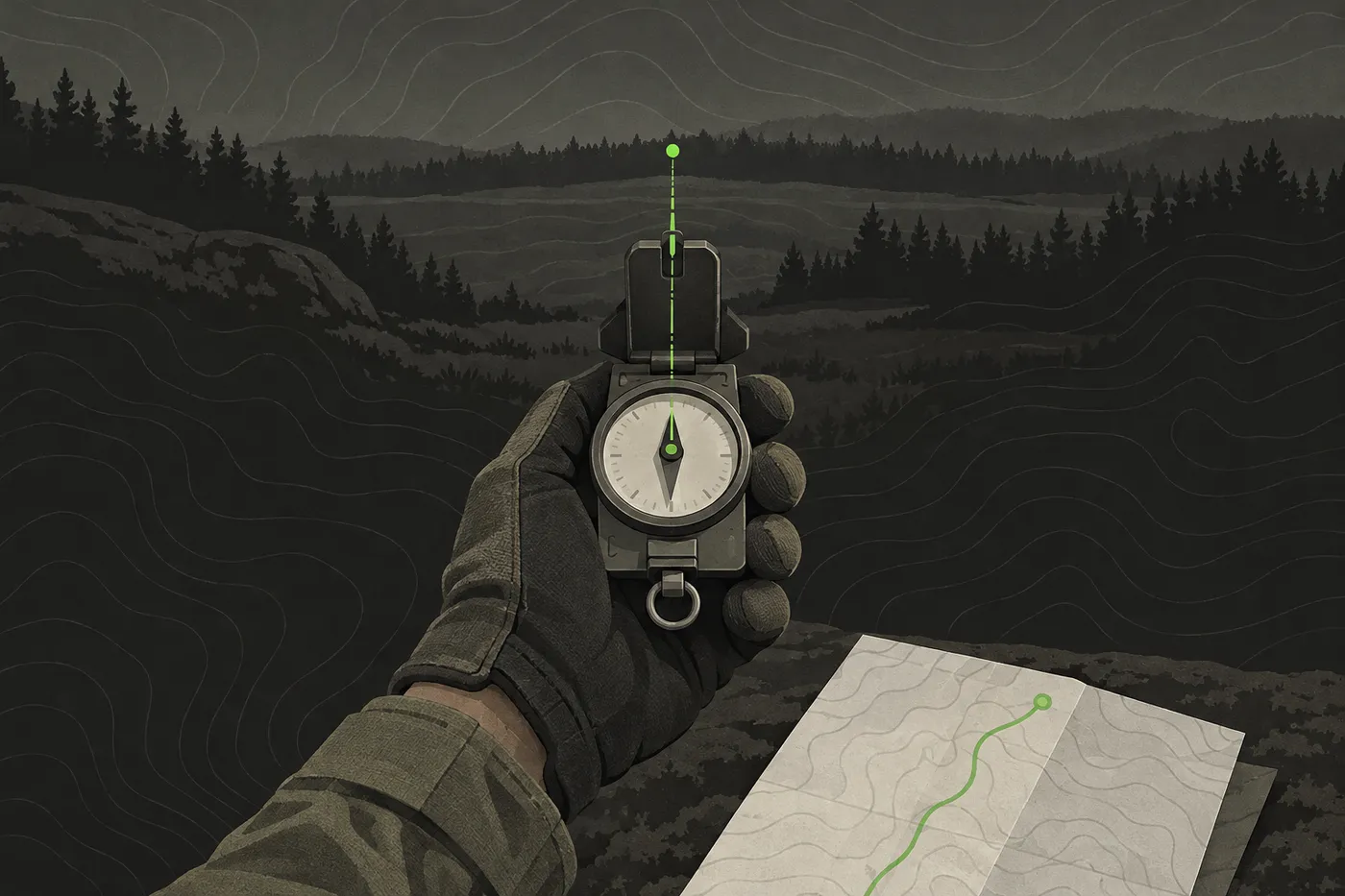
Hold the compass flat at chest height, turn your whole body until the needle sits inside the orienting arrow, and walk in the direction the travel arrow points, sighting a landmark ahead of you rather than staring at the dial the whole way. If you need to retrace the route, a back bearing, used to retrace a route, is the bearing in the exact opposite direction, 180 degrees apart from the one you walked out on, also called a reciprocal bearing.[3]
Roles
One player on the squad owns the compass and the map, calling bearings and grid references up to net control rather than leaving every player to read their own phone mid-game. A safety officer logs the bearing and grid reference to any reported injury the moment it comes over the radio, so medical help travels a straight line instead of following a shouted description.
For how a squad splits up comms, maps and safety more broadly, see how to organize a milsim event: a step-by-step checklist.
Safety and rules
Eye protection worn at all times on the field and a chronograph check before play are standard event norms at most organised airsoft and milsim games, enforced by marshals rather than by law.
Safety: a compass should not be used close to ferrous metal objects or electromagnetic fields, such as a car’s electrical system, an engine, or steel gear, since they can throw off its accuracy.[1] Step away from the truck before you take a bearing, not after you have already walked the wrong way.
If your organisation already runs a TAK Server, stay on ATAK for that link. TAK software, including ATAK and iTAK, shares information between clients using Cursor on Target (CoT) and chat-sharing features.[4] TacSync is not a TAK client, though an organiser can link a session to a TAK server (beta). A compass and a paper map do not care which app your team runs, which is exactly why they are worth carrying either way. More on that trade-off in TAK server and FreeTAKServer: does your airsoft team need one?
Common mistakes
- Reading the needle before it settles. Reading the bearing the instant the needle swings past, instead of waiting for it to settle, is the fastest way to walk a course a few degrees off without noticing. Wait the two or three seconds it takes to stop.
- Turning the dial instead of your body. Turning only the compass’s rotating housing to follow a bearing, instead of turning your whole body until the needle sits inside the orienting arrow, sends a squad toward the wrong tree line.
- Skipping declination because it sounds complicated. It is one subtraction. Skipping it is how two correct bearings, taken on two different compasses, end up pointing a squad to two different places.
Carrying a compass is not a backup plan for when the phone dies. It is the plan, with the phone as the backup.
Disclaimer: This guide is general information for airsoft, milsim and paintball games and for people learning about publicly available TAK software, not military, tactical or legal advice. Follow your field’s and event’s safety rules, marshal instructions and local law. ATAK, iTAK, WinTAK and TAK Server belong to their respective owners; TacSync is independent and not affiliated with the TAK Product Center. App features and prices change, so check the official listing before you rely on one.
Sources
- Compass. Wikipedia, accessed Oct 14, 2026.
- Magnetic declination. Wikipedia, accessed Oct 14, 2026.
- Bearing (navigation). Wikipedia, accessed Oct 14, 2026.
- TAK Product Center. TAK.gov, accessed Oct 14, 2026.
Frequently asked questions
What is the first step in using a compass with a map
Lay the compass's edge along the line connecting where you are standing to where you want to go, usually a rally point or an objective marked on the paper map.
Do you need to correct for declination when using a compass
Yes. A bearing read off the compass is converted to true north by adding or subtracting the local magnetic declination for that spot, and the amount changes from site to site.
What is a back bearing
A back bearing, used to retrace a route, is the bearing in the exact opposite direction, 180 degrees apart from the one you walked out on. It is also called a reciprocal bearing.
Can a compass be used near a car or metal gear
No. A compass should not be used close to ferrous metal objects or electromagnetic fields, such as a car's electrical system, an engine, or steel gear, since they can throw off its accuracy.
Is TacSync compatible with ATAK or TAK Server
Partly. TacSync is not a TAK client, but an organiser can link a session to a TAK server (beta), so TacSync players and markers appear in ATAK and iTAK, and TAK users appear on the TacSync map.
TacSync
Put your whole team on one live map.
Positions, markers, routes and chat in a private session. Join with a QR code, no server to set up.